
7 Mistakes You’re Making with Melanin-Rich Skin
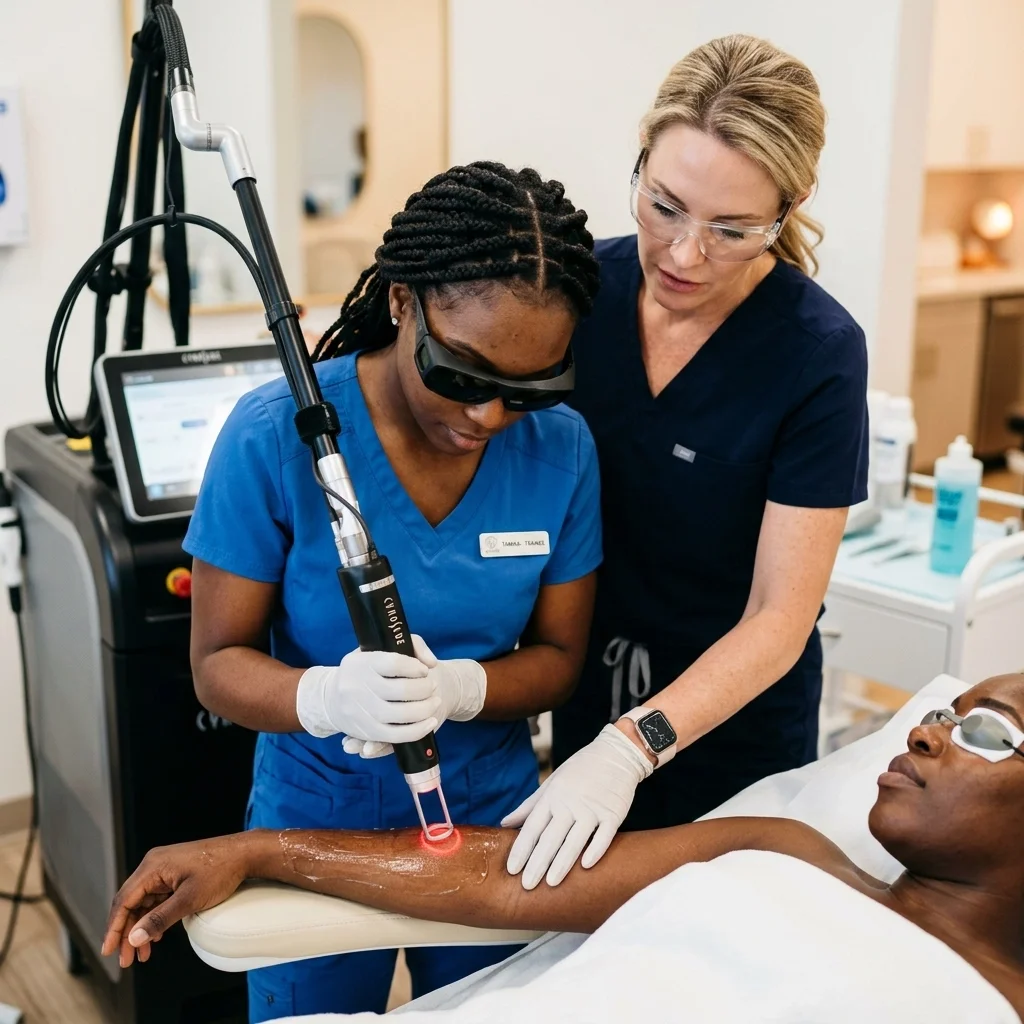
For years, the medical aesthetics industry had a major "blind spot." Most textbooks, training programs, and laser protocols were designed with Fitzpatrick types I and II in mind: essentially, light skin that burns easily and rarely tans.
But here’s the reality: the world is diverse, and so is your clientele. If you are treating melanin-rich skin (Fitzpatrick IV-VI) using the same "factory settings" you use for fair skin, you aren't just doing a disservice to your clients: you’re risking their safety.
At Luxury Aesthetics Institute, we believe that every skin tone deserves expert-level care. Whether you’re a licensed esthetician or a nurse looking to advance your practice, understanding the unique physiology of melanin-rich skin is the difference between a glowing success and a permanent scar.
Here are the seven most common mistakes professionals make with melanin-rich skin and how to fix them.
1. The "One-Size-Fits-All" Settings Trap
The biggest mistake is assuming that what works for a fair-skinned client will work for someone with a deeper complexion. Melanin-rich skin is highly reactive. When the skin detects heat or trauma, its natural defense mechanism is to produce more melanin.
If your laser settings are too aggressive, you aren't just targeting the hair or the pigment; you’re triggering a "fire alarm" in the skin. This leads to Post-Inflammatory Hyperpigmentation (PIH): those stubborn dark marks that can take months or even years to fade.
The Fix: You must learn to "start low and go slow." At the Luxury Aesthetics Institute, our Basic and Advanced Laser Technician Certification programs teach you how to adjust fluences, pulse widths, and cooling techniques specifically for darker skin tones to ensure safety without sacrificing results.
2. Using the Wrong Laser Wavelength (The IPL Danger)
Not all lasers are created equal. One of the most dangerous mistakes a technician can make is using IPL (Intense Pulsed Light) for hair removal on melanin-rich skin. IPL is a broad-spectrum light that isn't selective enough; it sees the melanin in the skin just as clearly as it sees the melanin in the hair follicle. This often results in "checkerboard" burns.
The Fix: The "Gold Standard" for melanin-rich skin is the 1064 nm Nd:YAG laser. This longer wavelength bypasses the surface melanin and travels deeper to target the root of the problem. Our Advanced Laser Certification focuses heavily on why the Nd:YAG is your best friend when treating diverse communities.
3. Over-Aggressive Chemical Peels
We all love the "glow" of a fresh peel, but deep chemical peels can be devastating for Fitzpatrick IV-VI. While a fair-skinned client might handle a high-percentage TCA peel with ease, that same peel could cause significant "hot spots" or even permanent hypopigmentation (white spots) on darker skin.
The Fix: Stick to superficial or "lunchtime" peels using Mandelic, Lactic, or Salicylic acids. These larger-molecule acids penetrate more slowly and evenly, reducing the risk of a "flash burn." We teach participants how to prep the skin for weeks before a peel to ensure the melanocytes are "quiet" and won't overreact to the treatment.
4. "Chasing" the Spot Instead of Treating the Field
When a client comes in with a dark spot, the instinct is to blast that one spot with everything you’ve got. This is a mistake. Melanin-rich skin often has "invisible" inflammation surrounding a visible mark. If you only treat the spot, you might end up with a halo effect: a light circle around a still-dark center.
The Fix: Treat the entire "field." Use tyrosinase inhibitors (pigment blockers) across the whole face or treatment area to regulate melanin production everywhere, then use targeted treatments conservatively. This creates an even, luminous complexion rather than a patchy one.
5. Skipping the Pre- and Post-Care Protocols
In many "fast-track" providers, participants are taught to just "cleanse and fire." But for melanin-rich skin, the treatment actually starts two to four weeks before the client even sits in your chair. Skipping the use of a daily pigment inhibitor (like Kojic Acid or Niacinamide) before a laser or microneedling session is a recipe for PIH.
The Fix: Education is key. You must act as a consultant, not just a technician. Our Melanin Rich Skin Education teaches you how to build a comprehensive home-care regimen that protects your clinical results.
6. Ignoring the Client’s Keloid History
Melanin-rich skin is statistically more prone to keloids: raised, thick scars that grow beyond the site of the original injury. If you perform an aggressive treatment (like deep microneedling or certain laser resurfacing) on someone with a history of keloids, you could cause permanent disfigurement.
The Fix: A thorough consultation is non-negotiable. Always ask about personal and family history of keloids, especially on the jawline, chest, and ears. If they have a history, you must adjust your modality to something non-ablative or less traumatic.
7. The Myth That "Black Skin Doesn't Need Sunscreen"
This is perhaps the most pervasive and dangerous myth in aesthetics. While melanin provides a natural SPF of roughly 13, it is not a shield against all UV damage. UV rays are the primary trigger for hyperpigmentation. If your client is doing laser treatments but skipping SPF, they are essentially pouring water into a bucket with a hole in the bottom.
The Fix: You must educate your clients on why sunscreen is their #1 anti-aging and pigment-correcting tool. Recommend mineral-based sunscreens with iron oxides to protect against visible light, which also contributes to melasma.
Why Luxury Aesthetics Institute is Different
Most providers offer a "one-size-fits-all" approach because it’s easier and faster. At Luxury Aesthetics Institute in Gilbert, Arizona, we don’t take the easy way. Our AZDHS-approved curriculum is designed by medical providers who understand the science of skin.
We pride ourselves on our Melanin Rich Skin Education. We don't just mention it in a sidebar; it is woven into the fabric of our Advanced Laser Technician training. We believe that to be a true expert, you must be able to treat every person who walks through your door with confidence and safety.
Our participants enjoy:
Small Cohort Sizes: You’ll get hands-on clinical training with top-tier equipment (including the 1064 nm Nd:YAG).
Licensed Instructors: Learn from medical professionals and industry experts who are currently working in the field.
Business Mentorship: We don't just teach you how to fire a laser; we teach you how to build a profitable, diverse-friendly business.
Are You Ready to Become an Expert?
The demand for aestheticians who truly understand diverse skin tones is skyrocketing. By mastering these protocols, you aren't just gaining a certification; you’re gaining a massive competitive advantage in the luxury beauty market.
Don’t let these 7 mistakes hold you back.
Click here to view our upcoming course schedule or ask about our payment plans today. Let’s change the face of aesthetics together.
